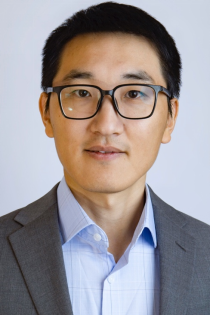
马晓栋,本科(2012年)、博士(2017年)均毕业于清华大学生物医学工程系,2017-2018年在上海联影工作,2019-2022年在明尼苏达大学完成博士后训练,2022年9月起在犹他大学放射学系任助理教授。他在博士期间开发了一系列基于多次激发的高分辨率弥散成像技术,这些技术有益于脊髓和盆腔等部位疾病的诊断。在明尼苏达大学做博士后期间,他从事7T弥散成像技术的开发,包括基于AI的并行发射方法,弥散成像的重建和去噪方法的改善。他目前的研究兴趣为超高场MRI成像和多对比度脑血管病MRI成像,。
Xiaodong Ma received his B.Eng. degree as well as the Ph.D. degree in Department of Biomedical Engineering from Tsinghua University, Beijing, China in 2012 and 2017. He worked at United Imaging as an MR sequence development engineer. He then completed Postdoc training at University of Minnesota in 2022. He started his faculty position as tenure-track assistant professor at University of Utah.
During his PhD program, he developed a series of high-resolution diffusion methods using multi-shot EPI and spiral, and successfully applied them to imaging different organs in patients, particularly in the spinal cord and pelvis. He extended these methods to ultra-high field MRI (7T) while he was a Postdoc Associate at University of Minnesota, by developing advanced brain MRI techniques including user-friendly parallel transmission (pTx), image reconstruction and denoising for diffusion MRI. Currently I am dedicated to develop fast and reliable multi-contrast MRI tools for neurovascular diseases, and translating their potential into the value of facilitating vascular imaging research and clinical practice.
